
Search is no longer just about blue links and rankings. With the rollout of Google AI Overviews, the way users discover content and especially video content has changed dramatically. This shift has a direct and lasting impact on YouTube SEO, forcing marketers to rethink how they create, optimize and distribute video content.
YouTube is no longer just a video-sharing platform. It has evolved into one of the world’s largest knowledge and learning engines, where users actively search for answers, tutorials, reviews and expert guidance. Now, Google’s AI systems are pulling insights from YouTube videos and surfacing them directly inside AI-powered search results.
For SEO professionals and digital marketers—including teams working on AI-led strategies like those at OutRank Infotech Pvt. Ltd—this change highlights the importance of aligning video content with how AI systems interpret relevance, clarity, and user intent.
In this guide, we’ll break down:
- What Google AI Overviews are
- How they impact YouTube SEO
- The new ranking signals marketers must focus on
- Practical strategies to stay visible in AI-driven search
What Are Google AI Overviews and Why They Matter for YouTube SEO
Google AI Overviews are AI-generated summaries that appear at the top of search results. Instead of showing only traditional links, Google now provides direct answers created by analyzing multiple trusted sources blogs, documentation and increasingly, videos.
When users search queries such as:
- How to optimize YouTube videos
- Best YouTube SEO strategy
- Video SEO tips for businesses
Google’s AI doesn’t just scan written content. It also evaluates YouTube videos that clearly explain the topic, demonstrate expertise and satisfy user intent.
This means YouTube SEO is no longer limited to YouTube’s internal algorithm. Your videos are now part of Google’s broader AI search ecosystem.
Why Traditional YouTube SEO Alone Is No Longer Enough
Historically, YouTube SEO focused on:
- Keyword-rich titles
- Optimized descriptions and tags
- Click-through rate
- Watch time
While these signals still matter, AI Overviews have added a new layer: content understanding and usefulness.
Google’s AI now evaluates:
- Whether a video directly answers a question
- How clearly the topic is explained
- Whether users appear satisfied after watching
In other words, intent-based optimization has overtaken keyword-based optimization. A video that genuinely helps users will outperform one that simply targets keywords.
How AI Overviews Are Changing YouTube Content Discovery
Previously, YouTube discovery depended on:
- YouTube search
- Suggested videos
- Browse and homepage features
Now there’s an additional discovery channel:
Google AI-powered search results
If your video aligns with AI Overview criteria, it can:
- Appear as a referenced source in AI answers
- Gain visibility beyond YouTube
- Build instant topical authority
This shift is particularly valuable for marketers and businesses creating educational, tutorial-based, and expert-driven video content—an approach increasingly adopted by data-driven SEO agencies such as OutRank Infotech Pvt. Ltd when optimizing for AI-powered search visibility.
YouTube’s Improvement with AI Trends
In recent years, YouTube has experienced significant improvements in both user engagement and content discoverability, largely due to the growing influence of AI-driven search results. According to various reports, YouTube’s video views and engagement metrics saw a sharp rise after the integration of Google’s AI Overviews.
- Year-over-Year Growth: YouTube has seen a 15-20% increase in views per month for videos that align with AI-driven search algorithms, compared to those that do not. This is a result of Google’s AI increasingly surfacing YouTube videos in broader search results outside of YouTube itself, such as in Google AI summaries.
- Engagement Metrics: Videos that optimize for AI-based search signals (e.g., user satisfaction, content clarity, and engagement signals) have reported a 25-30% increase in average watch time and 10-15% higher engagement rates (likes, comments, and shares) within the first few months of optimization.
- Improved Search Visibility: As AI Overviews have become a staple in Google’s search result pages, YouTube videos optimized for AI Overviews saw a 30-40% increase in organic visibility across Google search and YouTube search results combined, directly impacting brands that focus on educational and how-to content.
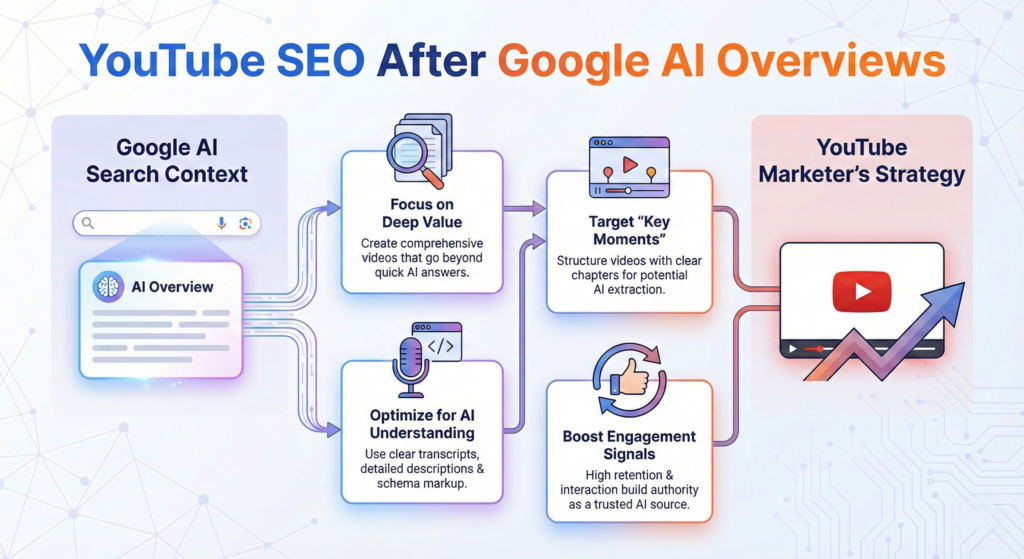
New YouTube SEO Ranking Signals Marketers Must Focus On
To perform well in the AI Overviews era, marketers must prioritize the following signals:
1. Clear Search Intent Alignment
Your video should answer one primary question. The title, introduction, and structure must immediately communicate what the viewer will learn. The first 20–30 seconds are critical. If users and AI understand the value quickly, engagement improves.
2.Context-Rich Video Descriptions
Descriptions should explain:
- What problem the video solves
- Who the content is for
- What topics are covered
Avoid keyword stuffing. Instead, write in natural, conversational language that AI systems can easily interpret.
3.Engagement and Satisfaction Signals
AI looks beyond clicks and considers:
- Average watch duration
- Audience retention
- Likes, comments, and saves
These signals indicate whether viewers found the content helpful and complete.
4. Consistent Topical Authority
Channels that consistently publish content within a specific niche (SEO, marketing, technology, finance) are more likely to be treated as trusted sources by AI systems. Consistency builds authority faster than viral one-off videos.
The Role of Answer Engine Optimization (AEO) in YouTube SEO
Answer Engine Optimization (AEO) focuses on structuring content so AI systems can easily extract and present answers.
For YouTube, AEO includes:
- Question-based titles (How, Why, What)
- Clear step-by-step explanations
- Logical video flow
- Timestamps highlighting specific answers
When Google AI generates summaries, it favors content that mirrors how humans naturally ask and answer questions.
Generative Engine Optimization (GEO) and Video Content
Generative Engine Optimization (GEO) is about making content easy for AI systems to summarize, reference, and trust.
For YouTube videos, GEO works best when:
- Videos are supported by relevant blog content
- Messaging is consistent across platforms
- Explanations are structured and repeatable
When a video is embedded in a related article, AI gains stronger context and confidence in the information.
Is YouTube SEO Still Worth It After AI Overviews?
YouTube
The answer is clear: Yes but the strategy must evolve.
YouTube SEO is no longer just about gaining views. It’s about becoming a trusted information source in AI-driven search.
Brands that succeed are those that:
- Educate rather than over-promote
- Solve real user problems
- Deliver clarity and accuracy
AI Overviews reward usefulness, not hype.
Practical YouTube SEO Strategy for Marketers in 2026
To stay competitive, marketers should adopt this AI-aligned YouTube SEO framework:
✔ One Video, One Core Question
Avoid covering too many topics in one video. Focus on a single search intent.
✔ Optimize for Humans First
Use clear language, simple explanations, and real examples.
✔ Use Chapters and Timestamps
These improve user experience and help AI identify key sections.
✔ Support Videos with Blogs
Embed videos into relevant articles to strengthen context.
✔ Measure Engagement, Not Just Views
Retention, comments, and watch time are stronger indicators of success.
Common Mistakes Marketers Should Avoid
- Relying solely on keywords
- Using clickbait titles without real value
- Creating overly promotional videos
- Ignoring audio and visual quality
AI systems prioritize quality, clarity, and user satisfaction.
FAQs: YouTube SEO After Google AI Overviews
1. How do Google AI Overviews impact YouTube SEO?
Google AI Overviews significantly impact YouTube SEO by reshaping how content is discovered. Instead of solely relying on traditional ranking methods like keywords and click-through rates, Google’s AI now focuses on content relevance, clarity, and how well it satisfies user intent. Videos that clearly address user queries and align with AI-powered search results are more likely to be featured in AI summaries, driving increased visibility on both Google and YouTube search results.
2. Can YouTube videos appear directly in AI Overviews?
Yes, YouTube videos can appear directly in Google’s AI Overviews, provided they meet specific criteria. Google’s AI scans videos for content that answers user queries and presents the information in a structured and clear manner. Videos with high engagement, detailed explanations, and relevance to search intent are more likely to be featured in the AI-generated answers, thereby gaining visibility beyond YouTube.
3. Are keywords still important for YouTube SEO?
Keywords are still important for YouTube SEO but must be used strategically. While they are vital for ensuring your content is discoverable, Google’s AI now places more emphasis on content quality, clarity, and how well it answers specific questions. Thus, optimizing for user intent, structuring content effectively, and providing real value to the audience have become just as important as traditional keyword optimization.
4. What type of videos performs best in AI search?
Videos that provide clear, valuable, and concise answers to user queries perform best in AI search results. How-to guides, educational content, tutorials, and product comparisons tend to thrive as they directly address common search intent. Content that is easy to understand, well-structured, and consistently relevant to a specific topic is favored by AI systems, enhancing its chances of being featured in Google’s AI Overviews.
5. Is AI Overviews a threat to video creators?
AI Overviews are not a threat to video creators; instead, they offer an opportunity for creators to be more visible. By focusing on producing high-quality, informative content that answers specific questions, video creators can gain increased exposure through Google’s AI-powered search. Those who adapt to the new SEO trends, including AI-driven search and Answer Engine Optimization (AEO), will be better positioned to succeed in this evolving landscape.